
 Contact
 Hours
Hours Location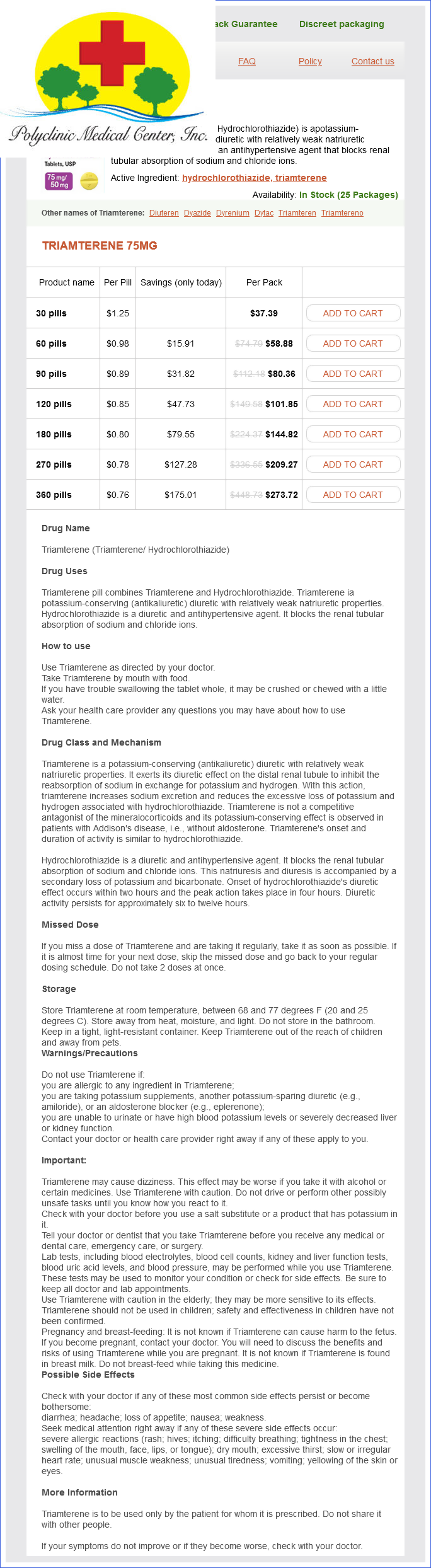
Triamterene dosages: 75 mg
Triamterene packs: 30 pills, 60 pills, 90 pills, 120 pills, 180 pills, 270 pills, 360 pills
Only $0.81 per item
In stock: 832
Description
The phenomenon of autoregulation consists of the intricate interplay of glomerulotubular feedback and myogenic response in afferent arterioles heart attack is recognized by discount triamterene 75 mg on-line. Prerenal azotemia may be encountered in both the volumedepleted and volume-overloaded patient (Box 46-1). True volume depletion may result from renal or extrarenal losses that result in systemic hypotension and renal hypoperfusion. In the volumeoverloaded patient, with edematous states such as cirrhosis and congestive heart failure, prerenal azotemia may occur because the kidney perceives that the vascular system is underfilled. Furthermore, hypotension is a powerful stimulus to the release of an antidiuretic hormone, which mediates water reabsorption. Hence urine production is characterized by low volume, decreased concentration of urinary sodium, increased urinary excretion of creatinine, and a high urine osmolality. In this setting, there is usually minimal, if any, evidence of parenchymal injury. Therapy for prerenal azotemia is directed at optimizing volume status with isotonic fluids. In patients with the edematous disorders who have prerenal azotemia, special efforts are directed toward treating the underlying disease states. The use of simultaneous liver-kidney transplantation is evolving (Nadim et al, 2012). Combination therapy with midodrine (a selective 1-adrenergic agonist) and octreotide (a somatostatin analogue) has been shown in a few small clinical trials to improve renal function and short-term survival (Angeli et al, 1999; Esrailian et al, 2007; Skagen et al, 2009). Diagnosis of urinary extravasation requires analysis of fluid from the area near the reconstructed site. Ratios of 10: 1 are virtually diagnostic for extravasation; however, smaller ratios may be observed when the urine has been diluted by other serous fluids. The reader is referred to other chapters in this text for more in-depth review of obstructive uropathy. This usually includes a renal biopsy and detailed serologic evaluation for the presence of systemic vasculitis, collagen vascular disease, and an infectious process. Specific therapies (including parenteral steroids, cyclophosphamide or other cytotoxics, and possibly plasma exchange) tailored to the disease entity diagnosed may be lifesaving. Patients with acute urinary tract obstruction may present with hematuria, flank or abdominal pain, or signs of uremia. A high index of suspicion for urinary tract obstruction should exist for patients with previous abdominal or pelvic surgery, neoplasia, or radiation therapy. Although oligoanuria suggests complete obstruction, partial obstruction may exist in the presence of adequate urinary output.
Syndromes
- Hormone levels
- Urinary urgency
- Men: Insert a finger into your rectum. Tighten the muscles as if you are holding in your urine, then let go. You should feel the muscles tighten and move up and down. These are the same muscles you would tighten if you were trying to prevent yourself from passing gas.
- Tissue death due to a blockage in blood flow (cerebral infarction)
- Kidney disease, such as a basic metabolic panel and urinalysis or ultrasound of the kidneys
- Severe infections or bleeding
- Liver failure
- Abdominal pain
- Imipramine: 150 to 300 ng/mL
- Percutaneous transhepatic cholangiogram (PTC)
Both renal lymphoma and leukemia are commonly silent but can be associated with hematuria blood pressure chart by weight generic triamterene 75 mg with amex, flank pain, or progressive renal failure. Fever, weight loss, and fatigue, the so-called B symptoms of lymphoma, are much more common (Zomas et al, 2004). Renal failure can be due to extensive replacement of the functioning parenchyma or bilateral ureteral obstruction associated with enlarged retroperitoneal lymph nodes (McVary, 1991). In reality, renal failure in such patients is more often related to medical causes, such as hypercalcemia or urate nephropathy, which can develop during systemic treatment of advanced disease. Most renal metastases are multifocal, and almost all are associated with widespread nonrenal metastases (Pollack et al, 1987; Choyke et al, 2003). The typical pattern of renal metastases consists of multiple small nodules that are often clinically silent, although they can lead to hematuria or flank pain in exceptional circumstances (Pollack et al, 1987). Renal metastases should be suspected in any patient with multiple renal lesions and widespread systemic metastases or a history of nonrenal primary cancer. If there is any uncertainty about the diagnosis, percutaneous renal biopsy usually provides pathologic confirmation (Sánchez-Ortiz et al, 2004a). Most patients with renal metastases are managed with systemic therapy or placed on a palliative care pathway, depending on the clinical circumstances. Nephrectomy is almost never required except in extenuating circumstances, such as renal hemorrhage that is refractory to embolization. In one study involving 100 consecutive patients with a renal mass and a history of nonrenal malignancy, none of the 54 patients without other evidence of disease progression had a renal metastasis (Rybicki et al, 2003; Sánchez-Ortiz et al, 2004a). Carcinoid tumors arise from neuroendocrine cells, which are not normally present in the kidney (Romero et al, 2006). This is thus a rare renal malignant neoplasm with fewer than 60 cases reported in the English literature (Hansel et al, 2007; Lane et al, 2007b; Canacci and MacLennan, 2008). An association with horseshoe kidneys has been reported, with previous studies showing an increased relative risk of 82-fold compared with normal kidneys (Begin et al, 1998; Romero et al, 2006). Carcinoid tumors stain positive for markers of neuroendocrine tissue such as neuronspecific enolase and chromogranin (Lane et al, 2007b). Measurement of urinary or plasma serotonin or its metabolites can be diagnostic (Kulke and Mayer, 1999). Only a minority of patients will present with the carcinoid syndrome-episodic flushing, wheezing, and diarrhea (Jensen and Doherty, 2001; Romero et al, 2006; Lane et al, 2007b). However, in a review of renal carcinoids, metastases were found in 46% of patients at diagnosis (Romero et al, 2006). Nephron-sparing surgery is preferred if the diagnosis is suspected preoperatively. Prognosis is good, particularly when associated with a horseshoe kidney (Begin et al, 1998; Lowrance et al, 2006). Significant adverse prognostic factors include age older than 40 years, tumor size greater than 4 cm, high mitotic rate, purely solid gross morphology, metastasis at initial diagnosis, and tumor extending through the renal capsule (Romero et al, 2006). Other neuroendocrine tumors, including small cell carcinoma and large cell neuroendocrine carcinoma, can occur in the kidney but are even less common than renal carcinoids (Gonzalez-Lois et al, 2001; Majhail et al, 2003; Lane et al, 2007b).
Specifications/Details
Ud Saleeb (Peony). Triamterene.
- Dosing considerations for Peony.
- What is Peony?
- Muscle cramps, gout, osteoarthritis, breathing problems, cough, skin diseases, hemorrhoids, heart trouble, stomach upset, spasms, nerve problems, migraine headache, chronic fatigue syndrome (CFS), and other conditions.
- Are there any interactions with medications?
- Are there safety concerns?
- How does Peony work?
Source: http://www.rxlist.com/script/main/art.asp?articlekey=96082
The most frequently identified organisms were Proteus mirabilis arterial nicking triamterene 75 mg purchase free shipping, Escherichia coli, Klebsiella species, Pseudomonas species, Enterococcus species, and Enterobacter species. The fragmentation of stones, despite sterile urine, may release preformed bacterial endotoxins and viable bacteria that place the patient at risk for septic complications (Scherz and Parsons, 1987; McAleer et al, 2002, 2003; Paterson et al, 2003). Therefore patients who have radiographic or clinical features suggestive of struvite or in whom infection is suspected should receive broad-spectrum antibiotics before surgery to reduce the risk for sepsis. Antibiotic treatment also may reduce bleeding secondary to inflammation and friability of renal parenchyma. Approximately one third of patients with an indwelling ureteral stent will, despite sterile urine on a preoperative analysis, be colonized with bacteria; Enterococcus and Staphylococcus epidermidis are the most frequent offending organisms (Reid et al, 1992; Lifshitz et al, 1999). For patients with indwelling stents, then, a course of antibiotic prophylaxis, particularly for gram-positive organisms, may be beneficial before instrumentation. Local anesthesia, usually in combination with intravenous sedatives and analgesics, has been reported in a number of centers (Clayman et al, 1983; Hulbert et al, 1986; Preminger et al, 1986; Ohlsen and Kinn, 1993; Li et al, 2013). A local anesthetic, such as lidocaine, can be delivered into the access tract by use of an 8. Currently, general anesthesia is usually preferred when a more lengthy procedure is planned because it is the best means of protecting the airway when patients are in a prone position. In cases in which upper pole puncture is contemplated, general anesthesia is preferred because it permits control of respiratory movements, which is essential to minimize the risk for pulmonary complications. Acute anemia from blood loss or dilution also may occur, emphasizing the need for frequent hemodynamic assessments. Because of the large amounts of fluids administered to the patient during nephroscopy there is a potential risk for hypothermia, a disorder associated with an increased risk for morbid cardiac events. Subsequent authors have reported their variations of the technique (Lahme et al, 2001; Li et al, 2010). The all seeing needle allows for visualization inside the kidney and directed laser lithotripsy using a 200-micrometer laser fiber (Desai et al, 2011). Postoperatively, pain is managed with opioid analgesia and antiinflammatory medication when not contraindicated. The fundamental techniques of gaining and maintaining percutaneous access are reviewed in Chapter 8. After the nephrostomy access has been appropriately dilated and the Amplatz sheath positioned, the urologist can proceed with stone removal by endoscopic techniques. However, fluoroscopically guided stone removal is no longer recommended because it is not as safe or as efficient as the removal of calculi under direct vision. The height of the irrigant during rigid nephroscopy should be maintained at 80 cm or less above the patient to minimize intrapelvic pressure and to prevent fluid absorption through pyelovenous backflow (Miller and Whitfield, 1985).
Related Products
Additional information:
Usage: ut dict.
Tags: discount triamterene 75 mg with visa, triamterene 75 mg order line, triamterene 75 mg order on line, triamterene 75 mg purchase fast delivery
10 of 10
Votes: 32 votes
Total customer reviews: 32
Testimonials
Ayitos, 52 years: Of the 111 patients with open pyeloplasty, 95 patients (86%) underwent dismembered pyeloplasty.
Kapotth, 54 years: Pediatric patients and select patients with renal insufficiency may warrant repair.
Tangach, 61 years: Adjuvant therapy has not proven to be effective, although the only survivors in the literature underwent radical surgery followed by pelvic radiation and/or androgen ablation.
Volkar, 32 years: Most patients are screened with pharmacologic nuclear medicine cardiac imaging or echocardiograms to evaluate myocardial perfusion, ejection fraction, and valvular function.
Felipe, 30 years: Prevention of radiographiccontrast-agent-induced reductions in renal function by acetylcysteine [see comments].
Dawson, 62 years: Pyridoxine and dietary counseling for the management of idiopathic hyperoxaluria in stoneforming patients.
Sigmor, 31 years: The mainstay of therapy for the prevention of recurrent bladder calculi involves relief of the bladder outlet obstruction.