
 Contact
 Hours
Hours Location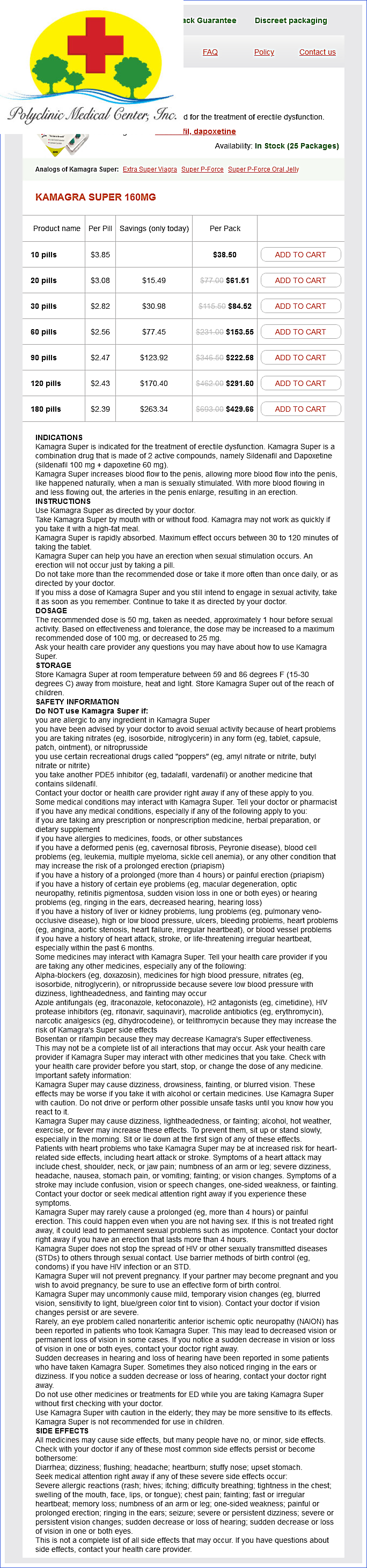
Kamagra Super dosages: 160 mg
Kamagra Super packs: 10 pills, 20 pills, 30 pills, 60 pills, 90 pills, 120 pills, 180 pills
Only $2.54 per item
In stock: 605
Description
This subtle airflow limitation cannot be identified by the usual recording of respiration using an oronasal thermistor erectile dysfunction treatment in kolkata 160 mg kamagra super buy overnight delivery. Nasal pressure monitoring with a nasal cannula is more sensitive than use of a thermistor in detecting airflow limitation and increased upper airway resistance (Ayappa et al. Note that peak increase in effort (arrow) is associated with a small drop in peak flow and tidal volume, causing a transient arousal on the electroencephalogram. CheyneStokes breathing is noted in patients with congestive heart failure (Javaheri, 2006; Javaheri and Somers, 2011; Javaheri and Dempsey 2013) and sometimes in renal failure. The test is conducted with the patient in the sitting position, the head held in a neutral position, the mouth wide open and relaxed, and the tongue protruding to the maximum. The subsequent classification is assigned based upon the pharyngeal structures that are visible. Class I = visualization of the soft palate, fauces, uvula, anterior and posterior pillars. The test was initially adapted to predict ease of intubation but can be used to predict the potential severity of obstructive sleep apnea. Even today, many physicians do not recognize the condition and mistake it for other superficially similar conditions. This division into three different requirements amongst three groups of physicians is unfortunate but it is hoped that in future these three groups would merge the criteria into uniform and consistent diagnostic criteria to avoid confusion among physicians in different specialties. An urge to move the legs, usually but not always accompanied by uncomfortable sensations in the legs. The urge to move the legs with any accompanying unpleasant sensations begins or worsens during periods of inactivity or quiescence such as lying down or sitting. The urge to move the legs with any accompanying unpleasant sensations is partially or totally relieved by movement, such as walking or stretching, as long as the activity continues. The urge to move the legs with any accompanying unpleasant sensations during rest or inactivity only occurs or is worse in the evening or night than during the day. The above features are not accounted for by another medical or behavioral condition. In the differential diagnosis, it is important to look for clues including subtle signs based on history and physical findings that point to the correct diagnosis. The history should include a detailed description of the present complaint, duration and nature of the sensory-motor complaints, as well as past, family, psychiatric, and drug histories. The prevalence appears to be much less in some surveys from Asia (<1%3%), suggesting the possibility of ethnic, racial, and environmental influence in susceptibility to disease. In most surveys, the prevalence is greater in women than in men, and the disease is gradually progressing (Hening et al, 2004).
Syndromes
- People with less free time have less time to exercise.
- Secondary hypertension occurs because of another disorder.
- Joint problems in severe cases when bleeding happens often
- Your doctor or nurse will tell you when to arrive at the hospital.
- Ethnicity
- Be present for days before any other symptoms appear
- You develop keloids and want to have them removed or reduced
- Insomnia
- Urinalysis
Nocturnal symptoms include habitual loud snoring impotent rage man kamagra super 160 mg order overnight delivery, choking during sleep, cessation of breathing, and abnormal motor activities during sleep. The other daytime symptoms include impairment of memory and motor skills, irritability, morning headache in some patients, automatic behavior, retrograde amnesia, and hyperactivity (in children). Physical examination may reveal obesity in approximately 70% of the cases, with increased body mass index and increased neck circumference, in addition to upper airway anatomical abnormalities causing reduction of the upper airway space. In severe cases physical examination may reveal evidence of congestive heart failure, cardiac arrhythmias, hypertension, and polycythemia. During sleep, muscle tone decreases, including that of the upper airway dilator muscles, which maintain upper airway patency. As a result of this decreased tone, these muscles relax, causing increased upper airway resistance and narrowing of the upper airway space. In children, adenotonsilar enlargement and craniofacial dysostosis causing narrow upper airway space are important factors. Neurological factors include reduced medullary respiratory neuronal output and ventilatory control instability which may create excessive response to respiratory muscles (high loop gain) promoting upper airway collapse and obstruction in susceptible individuals. Other neurological factors include autonomic activation during sleep-related breathing events, contributing toward development of hypertension and cardiac arrhythmias. Vascular factors contributing to the pathogenesis and long-term adverse consequences (Banno and Kryger, 2007; Javaheri and Somers, 2011) include increased endothelin 1 (a vasoconstrictor), reduced nitric oxide (a known vasodilator), and increased serum levels of vascular endothelial growth factor (glycoprotein responsible for vascular remodeling and atherosclerosis). Consequences of Obstructive Sleep Apnea Syndrome Obstructive sleep apnea syndrome is associated with increased morbidity and mortality as a result of both short-term (Strohl et al. Heart failure, mostly systolic heart failure but also diastolic heart failure (in which the studies are limited), is associated with both obstructive and central sleep apneas, but more central sleep apneas, including Cheyne-Stokes breathing, than obstructive apneas (Arias et al. The presence of central apnea, including Cheyne-Stokes breathing, increases the mortality in patients with heart failure. There has been an increased association Evaluation and Assessment Evaluation and assessment are the same as for other sleep disorders. Particular attention should be paid to the detailed sleep history as well as the daytime history, and careful physical examination should be focused on specific associated and risk factors, specifically body mass index, cardiopulmonary examination, and an examination of the upper airways (neck circumference, airway size). The laboratory assessment and management are described in this chapter, under Laboratory Assessment of Sleep Disorders. Some investigators have rejected it as a distinct clinical entity, whereas others have accepted it as such. A high concordance (83%) in monozygotic twins and complex segregation analysis suggest an autosomal dominant mode of inheritance (Hening et al. Linkage analysis documented significant linkage to at least five different chromosomes (12q, 14q, 9p, 2q, and 20p). Four allelic variations in different genes have been identified on chromosomes 2p, 6p, 15q, and 12q. These creeping sensations occur mostly between the knees and ankles, causing an intense urge to move the limbs to relieve these feelings. Sometimes, similar symptoms occur in the arms or other parts of the body, particularly in advanced stages of the disease or when the patient develops augmentation (a hypermotor syndrome with symptoms occurring at least 2 hours earlier than the initial period, with intensification and spread to other body parts) resulting from long-standing dopaminergic medications (Allen et al.
Specifications/Details
Lungmoss. Kamagra Super.
- Dosing considerations for Lungmoss.
- Are there safety concerns?
- How does Lungmoss work?
- What is Lungmoss?
- Bronchitis, asthma, coughs, inflammation, promoting sweating, and other uses.
Source: http://www.rxlist.com/script/main/art.asp?articlekey=96162
As with other neurodegenerative diseases erectile dysfunction in young age kamagra super 160 mg fast delivery, there is no standard method for determining disease severity or its rate of change over time. Studies relying on clinical rating scales must be quite large and adequately powered to detect the protective effect. Apparently, continued production of the mutant protein is required for maintenance of cell dysfunction and ultimately for cell death. Patients with chorea are often unaware of or untroubled by their involuntary movements (Jankovic and Roos, 2014). Selective serotonin reuptake inhibitors seem to improve irritability, aggression, depression, and obsessivecompulsive symptoms. Irritability may respond to carbamazepine and some of the newer antiepileptic drugs. Quetiapine has been reported to be useful in patients with irritability and aggression. Dentatorubral-Pallidoluysian Atrophy Dentatorubral-pallidoluysian atrophy is an inherited neurodegen erative disease that appears to be rare outside Japan but has been found to be relatively common in North Carolina, hence the alternative term Haw River syndrome. Neurodegeneration may also be found in the cerebral white matter, putamen, medulla oblongata, and spinal cord. Because of the polyglutamine stretch in the mutant protein, neurodegeneration likely relates to interactions between the protein, other cellular components, and cellular proteins. Clinical differences include lack of myoclonic epilepsy and the presence of subcortical white matter demyelination, basal ganglia calcifications, and neu roaxonal dystrophy. Acanthocytes are seen in peripheral blood smears in patients with three neurological syndromes: abetalipopro teinemia, neuroacanthocytosis, and McLeod syndrome (Walker et al. A broad spectrum of movement disorders is seen in neuroacanthocytosis and McLeod syndrome. Auto somal recessive neuroacanthocytosis is characterized by onset at around age 35 years of a progressive syndrome that includes a movement disorder and behavioral and cognitive changes. The movement disorder predominantly consists of chorea, dystonia, and tics; parkinsonism may occur in more advanced stages. There is also prominent orofacial dystonia with dys tonic tongue protrusion interfering with eating. In addition, many patients exhibit lip and tongue biting and prominent dysarthria and dysphagia. There may be myopathy or axonal neuropathy, and the creat ine kinase level is elevated. In patients with neuroacanthocy tosis, acanthocytes usually make up 5% to 20% of peripheral blood erythrocytes.
Related Products
Additional information:
Usage: q.d.
Tags: kamagra super 160 mg with visa, cheap kamagra super 160 mg with mastercard, 160 mg kamagra super buy with mastercard, buy discount kamagra super 160 mg on-line
9 of 10
Votes: 37 votes
Total customer reviews: 37
Testimonials
Kapotth, 36 years: The internalization of most peroxisomal matrix proteins occurs via one of two targeting sequences in a unique system enabling the importation of oligomerized proteins through a specific shuttle involving a receptor and its cargo.
Esiel, 49 years: Agalsidase alfa has also been shown to be beneficial in cardiac, renal, neuropathic pain, and quality-of-life measures (Mehta et al.
Arokkh, 39 years: This is an indicator of their visuospatial and visuomotor difficulties, which are an extremely common feature of the disorder.
Merdarion, 63 years: In addition, adhesion molecules and matrix metalloproteinases are critically involved in facilitating recruitment and transmigration of activated T cells and monocytes through the bloodnerve barrier.
Xardas, 55 years: These patients have a lesion at the level of the sacral ala, with involvement of the lumbosacral trunk.