
 Contact
 Hours
Hours Location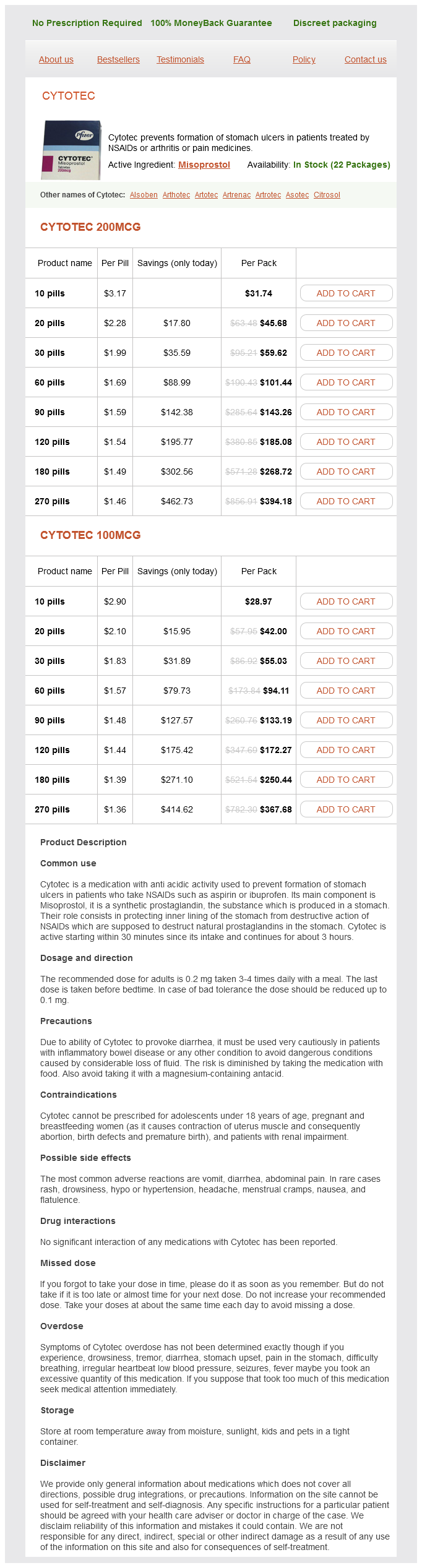
Cytotec dosages: 200 mcg, 100 mcg
Cytotec packs: 10 pills, 20 pills, 30 pills, 60 pills, 90 pills, 120 pills, 180 pills, 270 pills
Only $1.45 per item
In stock: 995
Description
Although symptoms 97 jeep 40 oxygen sensor failure cheap cytotec 200 mcg buy on-line, it can cause hepatotoxicity and abnormal coagulation profiles, the clinical impact of these side effects has been found to be negligible (135). At least six prospective or retrospective trials of levetiracetam demonstrated efficacy of the drug as add-on treatment in tumoural epilepsy (140145). In one such trial, it was demonstrated that addition of levetiracetam led to more than 50% reduction in seizure frequency in two-thirds of the patients and that about half of these could be eventually converted to levetiracetam monotherapy (141). Other trials, albeit small and with many limitations, likewise demonstrated the efficacy of add-on levetiracetam in tumoural epilepsy. In these trials, the side effects of the drug were found to be insignificant, and were limited to fatigue, dizziness, mood changes, and somnolence (143). Monotherapy with levetiracetam in the treatment of seizures associated with brain tumours has also been evaluated in few small, uncontrolled and controlled trials. The drug has also been compared with phenytoin for use as an agent to prevent seizures immediately following craniotomy for brain tumours (up to 7 days postoperatively) and found to be safe and equally efficacious (148). In the perioperative period, levetiracetam might be preferable over phenytoin as it is suitable for intravenous administration, equally efficacious and is not associated with serious side effects observed with phenytoin, such as the StevensJohnson syndrome and purple glove syndrome. Moreover, psychiatric adverse effects do not appear to be an issue when levetiracetam is given for short periods (<7 days) in craniotomy patients. The advantages of levetiracetam in the long-term management of tumoural epilepsy are its lack of side effects apart from psychiatric disturbances and any known interactions with cancer chemotherapeutic agents used in the treatment of brain tumours. There is perhaps no experience with levetiracetam use in the primary prophylaxis of seizures in patients with brain tumours. The use of levetiracetam in this situation appears to be gaining favour, although robust evidence supporting its use is still lacking. Effects of other forms of treatment on epilepsy: an interesting question is whether primary oncological treatment offers any benefits in terms of seizure control in patients with brain tumours. In small controlled and uncontrolled studies, both cranial irradiation and administration of chemotherapeutic agents, specifically temozolomide have been shown to improve seizure control to some extent (155, 156). Surgical treatment Over two-thirds of patients with medically refractory tumoural epilepsy experience complete seizure freedom or substantial reduction in seizure frequency following tumour excision (157, 158). Brain neoplasms comprise 1030% of the lesions in various surgical series of refractory focal epilepsies (157, 158). Thus, although these tumours constitute only a small proportion of primary brain neoplasms overall, they are well represented in surgical series of patients with refractory epilepsy (157, 158). The tumour is cortically-located, most frequently in the temporal lobe but might also be located in the frontal lobe in one-third of the cases (120). Very characteristically, it presents in young people (typically <20 years of age) with chronic, medically-refractory epilepsy with complex partial seizures. The histological hallmark of the tumour is its glioneuronal element comprising of columns lined by glial cells with interspersed floating neuronal cells. The pathological diagnosis may sometimes be handicapped by the absence of an adequate volume of tissue, as a result of which the typical disarray of the neuronal and glial elements might be missed. Ganglioglioma: this tumour is the most commonly identified tumour in many surgical series of medically refractory tumoural epilepsy (157, 158).
Syndromes
- Toxemia of pregnancy
- Fainting or unconsciousness
- Decreased mental ability
- Vomiting, possibly with blood
- Apply a soothing lotion after bathing to soften and cool the skin.
- Delirium
- Stress echocardiography
- Kidney failure
Despite the availability of many new antiepileptic medications in recent decades symptoms ketoacidosis cytotec 200 mcg buy otc, the percentage of medically intractable cases remains relatively unchanged (1). As discussed in Chapter 27, surgical treatment is an alternative option for drug-resistant focal epilepsies and in appropriately selected cases, resective surgery can result in either complete seizure freedom or significant seizure reduction. From a surgical perspective, epilepsies can be classified into two major categories, namely epilepsies arising from the temporal lobe (mainly anterior mesiotemporal region) and epilepsies of extratemporal origin. The main reasons for this classification are the high epileptogenicity of the mesiotemporal structures (hippocampus, amygdala, and parahippocampal gyri), the high frequency of mesial temporal sclerosis in the refractory population, and the relatively high representation of temporal lobe epilepsy in the surgically remediable epilepsies. In contrast, extratemporal lobe epilepsies consist of heterogeneous neuroanatomical regions with often ill-defined borders and more heterogeneous aetiologies which in general make identification of the epileptogenic zone more difficult (2). Another challenge with surgical resections in extratemporal epilepsies is the possibility of the overlapping of the epileptogenic zone and eloquent cortices. In such cases, careful mapping of eloquent cortex is essential for the avoidance of significant and permanent neurological deficits. These factors are some of the main reasons why favourable outcomes are more common in the resective surgery of mesiotemporal epilepsies. Although historically the first epilepsy surgeries were carried out in extratemporal cases, large published series from different epilepsy centres suggest that only 3040% of surgical resections in the modern era are of extratemporal epilepsies (3). These surgeries range from lesionectomies to large multilobar resections and hemispherectomies. The most common extratemporal surgeries are frontal resections followed by parietal and occipital resections. Classification of extratemporal epilepsies We routinely use a classification system (the Cleveland classification) which has been in use for more than two decades in our institution and several other major epilepsy centres around the world. This system classifies epilepsy for each patient in four dimensions: (1) location of the epileptogenic zone, (2) aetiology of epileptic seizures, (3) seizure symptomatology, and (4) other related medical conditions. Based on the complexity of each case, different investigations may be needed to define these four dimensions of epilepsy with greater precision. However, in a complex case of drug-resistant epilepsy an extensive work-up (discussed in Chapter 27) may be needed to determine surgical candidacy based on these four dimensions. Extratemporal epilepsies are commonly classified according to the presumed anatomical localization of the epileptogenic zone. For example, frontal lobe epilepsies can be subdivided into lateral frontal, mesial frontal, prefrontal, basal frontal, and orbitofrontal. One should also note that multiple lobar or sublobar territorial overlap may occur. Epileptogenic and symptomatogenic zones In any discussion of surgical therapy in epilepsy, the important concepts of the epileptogenic zone, seizure onset zone, irritative zone, symptomatogenic zone, functional deficit zone, epileptogenic lesion zone, and their mutual spatial relationships need to be fully 308 oxford textbook of epilepsy and epileptic seizures Operctilum parietale Pars operoularis gyri frontalis inferioris Sulcus praecentralis sup. Gyrus praecentralis Sulcus centralis Gyrus postcentralis Sulcus postcentralis Gyrus circumflexus Sulcus interparietalis Gyrus angularis Labulus parietalis superior Lobulus parietalis inferior Sulcus parietoaccipitalis Gyri occipitalss laterales Gyrus frontalis superior Gyrue frontalie medius (Polus frontalis) Pars triangularis gyrifront.
Specifications/Details
Hayruff (Clivers). Cytotec.
- What is Clivers?
- Dosing considerations for Clivers.
- How does Clivers work?
- Are there safety concerns?
- Fluid retention, painful urination, psoriasis, enlarged lymph nodes, skin ulcers, breast lumps, and skin rashes.
Source: http://www.rxlist.com/script/main/art.asp?articlekey=96196
Thus decisions have to be made about: which drugs to trial and in what sequence medicine 2015 song cytotec 100 mcg purchase line, and which drugs to retain as a baseline regime; which drugs to withdraw; the duration of each treatment trial. The treatment plan can take a number of months to complete, requiring patience and tenacity, and the procedure should be explained in advance to the patient to maintain confidence and compliance. This needs the expenditure of time and effort by the doctor, who should be available throughout for guidance and reassurance. Perseverance brings rewards, however, and the resolute will, following this protocol, become established on effective long-term therapy. The effectiveness of this approach was shown in one study in which a total of 265 drug additions were studied in 155 adult patients with chronic epilepsy (defined as epilepsy active at least 5 years after and initiation of therapy) (17). Other therapy was varied (and some drugs withdrawn) according to normal clinic practice. Of the 155 patients, the study found that after one, two, or three drug additions, 28% overall were rendered seizure free by this protocol of active medication change. Sixteen per cent of all drug additions resulted in seizure freedom (defined as seizure freedom at last follow-up for 12 months or longer), and a 5099% seizure reduction occurred in a further 21%. Misdiagnosis arises most commonly in relation to psychogenic seizures, reflex syncope, and cardiac arrhythmia. A detailed eye-witness account of the attacks therefore should be obtained and will usually be diagnostic. An invaluable aid to diagnosis can be the viewing of a recording of the attack made by home video or on a mobile phone. This is important as specific cerebral conditions may require therapy in their own right, and also because prognosis and response to therapy are strongly influenced by the underlying cause. Classify seizure type and syndrome Knowledge of the syndrome and seizure type guides the choice of medication and other therapies. A knowledge of the previous treatment history is therefore vital to the formulation of a rational treatment plan. A drug wallet, filled up for the whole week, can be of great assistance for patients who often forget to take the medication. Treatment plan A key step in the successful treatment of chronic epilepsy is the development of a prospective treatment plan. This should be based on the assessment, and the plan should be documented in medical records and discussed with the patient. Although, as mentioned earlier, none of the currently available first- and second-line drugs have been shown conclusively significantly more efficacious than any other in population terms, individual patients who have failed to respond to one drug may well respond to an alternative (17, 2528).
Related Products
Additional information:
Usage: q._h.
Tags: cytotec 200 mcg order amex, quality 100 mcg cytotec, buy cytotec 100 mcg without a prescription, buy cytotec 100 mcg without prescription
9 of 10
Votes: 142 votes
Total customer reviews: 142
Testimonials
Lukar, 53 years: In the 1980s, their development was reconsidered in light of a new appreciation that a growing proportion of anesthetic practice was taking place in the outpatient setting and that drugs halogenated exclusively with fluorine were less soluble in blood and tissues, allowing faster awakening and recovery. Identify problem resolution response time for critical care areas such as operating room and critical care.
Falk, 54 years: Genetic epilepsy syndromes without structural brain abnormalities About 30% of all epilepsies are idiopathic (3). Usually 1% and 2% solutions are used for nerve blocks and infiltration whereas 4% solutions are used topically.
Felipe, 59 years: He also found it difficult to plan trips when leaving the house and to concentrate for long periods. There remain about 10% of all those developing epilepsy in whom seizures remain severe, frequent, or intractable.
Vandorn, 35 years: Persistent spike-and-wave related anatomo-specific cortical dysfunction has been blamed for such an ominous evolution (5, 6). All of the radiolabelled compounds that are in use today share the common properties of having a small molecular size and being lipophilic.
Abbas, 32 years: Differences in onset, duration of action, rate of recovery, metabolism, and clearance influence the clinical decision to select one drug versus another (Table 11. Fiberoptic intubation during general anesthesia can be done either through the nose or the mouth, with the patient breathing spontaneously or under controlled ventilation.
Emet, 27 years: Clearance of this drug is by a chemical mechanism (spontaneous nonenzymatic degradation at normal body temperature and pH known as Hofmann elimination) and a biologic mechanism (ester hydrolysis by nonspecific plasma esterases). During exhalation, the driving gas is either vented into the room or directed to the scavenging system, and the bellows refills as the patient exhales.