
 Contact
 Hours
Hours Location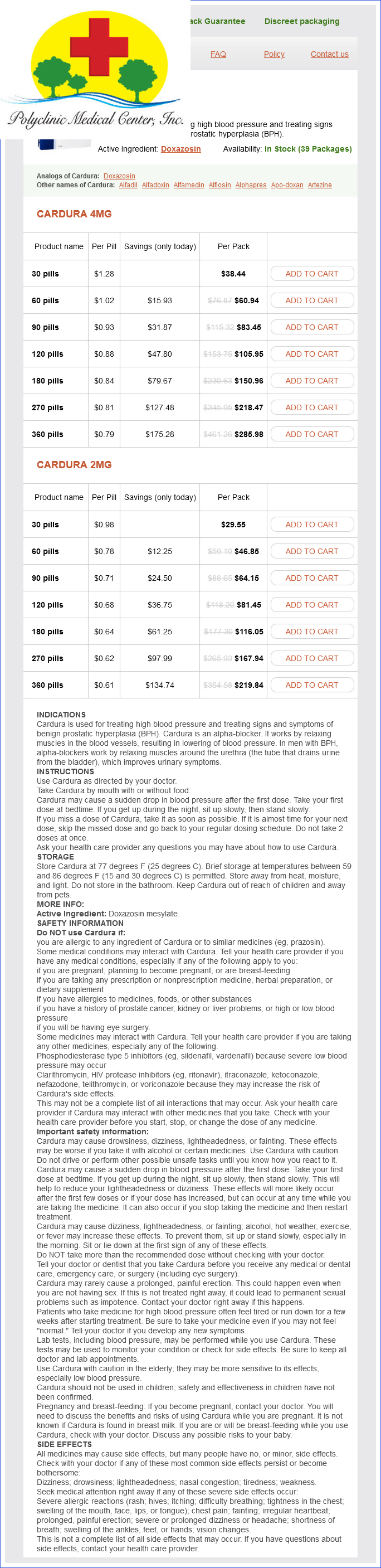
Cardura dosages: 4 mg, 2 mg, 1 mg
Cardura packs: 30 pills, 60 pills, 90 pills, 120 pills, 180 pills, 270 pills, 360 pills
Only $0.25 per item
In stock: 578
Description
Consider the simplest case hypertension nih purchase cardura 4 mg on-line, in which the receptor is either simplest p, which the receptor is either c receptor either ree (unoccupied) or reversibly bound to drug (occupied). When either a drug or an endogenous ligand (such as a hormone or neurotransmitter) binds to its receptor, a response may result rom that binding interaction. When a su f cient number o receptors are bound (or "occupied") on or in a cell, the cumulative e ect o receptor "occupancy" may become apparent in that cell. At some point, all o the receptors may be occupied, and a maximal response may be observed (an exception is the case o spare receptors; see below). When the response occurs in many cells, the e ect can be seen at the level o the organ or even the patient. But this all starts with the binding o drug or ligand to a receptor (or the purpose o discussion, "drug" and "ligand" will be used interchangeably or the remainder o this chapter). A model that accurately describes the binding o drug to receptor would there ore be use ul in predicting the e ect o the drug at the molecular, cellular, tissue (organ), and organism (patient) levels. At equilibrium, the raction o receptors in each state is dependent on the dissociation constant, Kd, where Kd ko /kon. Although Kd varies with temperature, the temperature o the human body is relatively constant, and it can there ore be assumed that Kd is a constant or each drugreceptor combination. Because Kd is a constant, some important properties o the drugreceptor interaction can be deduced rom this equation. First, as ligand concentration is increased, the concentration o bound receptors increases. Second, and not so obvious, is that as ree receptor concentration is increased (as may happen, or example, in disease states or upon repeated exposure to a drug), bound receptor concentration also increases. There ore, an increase in the effect of a drug can result from an increase in the concentration of either the ligand or the receptor. Why does the act that a drug has a low therapeutic index mean that the physician must use greater care in its administration What properties o certain drugs, such as aspirin, allow them to be taken without monitoring o plasma drug levels, whereas other drugs, such as heparin, require such monitoring One might intuitively expect the doseresponse relationship to be related closely to the drugreceptor binding relationship, and this turns out to be the case or many drugreceptor combinations. Thus, a use ul assumption at this stage o discussion is that the response to a drug is proportional to the concentration o receptors that are bound (occupied) by the drug. Because drug responses occur over a wide range o doses (concentrations), the semilog plot is o ten used to display drugreceptor binding data. Thus, Kd can be def ned as the concentration o ligand at which 50% o the available receptors are occupied. Because o this relationship, Drug A, which has the lower Kd, will bind a higher proportion o total receptors than Drug B at any given drug concentration.
Syndromes
- Thyroid hormone
- Wearing too much clothing
- Watch the area for signs of infection such as redness, swelling, pain, or drainage.
- You also have a dry mouth.
- Gallstones
- Did the absence of thirst develop suddenly or slowly?
- Weakening of the heart muscle (cardiomyopathy)
- Ehlers-Danlos syndrome
- Difficulty walking
- Referral to a mental health provider
Since he has hepatomegaly and crackles on lung auscultation blood pressure chart guidelines 1 mg cardura buy overnight delivery, additional fluid administration would worsen his condition, therefore the best next step is to start an epinephrine infusion. Shock is the condition of oxygen and nutrient delivery insufficient to meet end-organ metabolic demands. Management includes optimizing oxygen delivery, which is the product of cardiac output and oxygen content. Cardiac output is stroke volume multiplied by heart rate, and oxygen content is mostly dependent on hemoglobin concentration and percentage of saturated hemoglobin. Although classifications change, types of shock include hypovolemic, cardiogenic, distributive, and septic. Regardless of the type of shock, fluid management can be assisted by an algorithm such as the one shown in Item C225,along with frequent clinical reassessment for hemodynamic status. Once shock is identified in a patient based on signs such as altered mental status, delayed capillary refill, tachycardia, or hypotension, airway and breathing is established, and intravenous or intraosseous access is established in the first few minutes. Rapid boluses of isotonic fluid up to and over 60 mL/kg are given in the first 15 minutes until shock is reversed or until rales or hepatomegaly develop, at which point inotropic medications are started. When these algorithms are followed, patients with cardiogenic shock are identified by the development of pulmonary edema, hepatomegaly, or worsened circulation with heart failure. Findings include tachycardia, tachypnea, delayed capillary refill, and signs of dehydration. Extremities are usually cool because of the compensatory mechanism of vasoconstriction. Hypovolemic shock is usually reversed with fluid administration alone and is less likely to require inotropes. In contrast, septic shock is systemic inflammation caused by an infection leading to shock. The effect of the bacterial toxin, if present, and the host inflammatory cascade cause arteriolar vasodilation, cardiac depression, and increased capillary permeability. However, septic shock can be distinguished from hypovolemic shock by the presence of fever, decreased cardiac function, vasodilation with "flash" capillary refill, capillary leak, and inotropic requirement. Whereas hypovolemic shock is usually "cold" shock, septic shock may be either "warm" or "cold" depending on the degree of vascular tone. The boy in this vignette has septic shock evidenced by signs of infection, systemic inflammation, and shock. Hydrocortisone has been shown to reverse shock in patients at risk of adrenal insufficiency and in patients with catecholamine-resistant shock, but neither is occurring in the boy in this vignette. Double volume whole blood exchange transfusion can be effective in meningococcemia and multiple organ failure, but a more immediate need is to reverse the shock. Starting an epinephrine infusion would be the best next step in reversing the shock.
Specifications/Details
Shou Wu (Fo-Ti). Cardura.
- Are there safety concerns?
- How does Fo-ti work?
- Liver and kidney problems, high cholesterol, insomnia, lower back and knee soreness, premature graying, dizziness, and other conditions.
- Are there any interactions with medications?
- What is Fo-ti?
- Dosing considerations for Fo-ti.
Source: http://www.rxlist.com/script/main/art.asp?articlekey=96750
Placement in the knee chest position is the best first intervention if a hypercyanotic spell is suspected blood pressure quick reduction buy cardura 2 mg amex. As this worsens, the oxygen saturation may decrease slowly over time and the pulmonic stenosis murmur will increase in intensity. As a result, the blood arriving at the peripheral circulation will be acidotic and hypoxemic. Acidosis will cause hyperventilation, which increases return of blood to the right ventricle. A greater and greater percentage of the blood sent to the peripheral circulation will be desaturated as the spell progresses, and will manifest as lower and lower systemic saturations seen on pulse oximetry. The pulmonic stenosis murmur during a hypercyanotic spell will become softer, as evidence of the decrease in pulmonary flow. Bag-mask ventilation would help to decrease the carbon dioxide level and increase the systemic pH, but would not address the underlying pathophysiology. Providing 100% oxygen would be helpful, ensuring that the circulating blood volume is as well saturated as possible. Intravenous furosemide would worsen the situation, decreasing the blood volume reaching the lungs as well as the systemic circulation. In this case, there is too little pulmonary flow, and a fluid bolus would be a good intervention after performing a knee-chest maneuver. If sedation is indicated to calm the infant and decrease hyperventilation, morphine would be the drug of choice (after performing the knee-chest maneuver, providing oxygen and a fluid bolus). Early reports suggest that intranasal fentanyl may be effective as well because of its rapid absorption. Oral propranolol would not be effective for initial management of a rapidly progressing hypercyanotic spell. Propranolol is thought to help relax the infundibulum or subpulmonic muscle bundles. Propranolol may cause or worsen hypotension in a volume-depleted patient, thereby decreasing pulmonary blood flow, so it would not be a good first intervention. If these measures are unsuccessful, sodium bicarbonate should be considered to reverse the metabolic acidosis and decrease the secondary hyperventilation. Tetralogy of Fallot with pulmonary stenosis, pulmonary atresia, and absent pulmonary valve. He is cruising but not independently walking, and his parents report that he is difficult to feed, spits out his food, and seems to have difficulty swallowing. He has lost 1 kg since his most recent visit 6 months ago, and his weight is now less than the third percentile. You have referred them to an early intervention program, but his father refused to let the early intervention providers in their home. You have referred them to a gastroenterologist, a feeding specialist, and a neurologist, but they missed these appointments and have not rescheduled. Cab vouchers have been provided to the family for travel to their specialty appointments.
Related Products
Additional information:
Usage: p.c.
Tags: cardura 1 mg buy with amex, purchase cardura 2 mg free shipping, 1 mg cardura purchase amex, cardura 2 mg for sale
9 of 10
Votes: 344 votes
Total customer reviews: 344
Testimonials
Kapotth, 24 years: At higher rates o in usion (210 g/kg per min), dopamine is a positive inotrope via its activation o 1-adrenergic receptors. Urinary alkalinization can be achieved by oral bicarbonate, supplemented as needed by a carbonic anhydrase inhibitor to reduce renal reabsorption o the ltered bicarbonate. Falls from significant heights and child abuse can be additional causative mechanisms. She routinely uses albuterol before gymnastics, and additional short-acting b-agonist therapy 4 to 5 times per week for dyspnea and fatigue with vigorous exertion.
Akascha, 32 years: She admits they frequently had sex without condoms and smoked marijuana and tobacco often, but she denies any intravenous drug use and has never witnessed him using any intravenous drugs. Stimulation o cardiac 1-receptors (which represent 7080% o all cardiac -adrenergic receptors) causes an increase in both inotropy (orce o contraction) and chronotropy (heart rate). Damage to the nasal mucosa and possible rebound hypersensitivity and return o symptoms o ten accompany extended use o these medications. Sortilin acilitates the post-translational degradation o apoB by a lysosome-dependent mechanism.
Shawn, 58 years: A practical overview of managing adolescent gynecologic conditions in the pediatric office. Nontyphoidal Salmonella typically cause enteritis, though invasive infections including bacteremia, osteomyelitis and meningitis can occur. Although antibiotics and oral corticosteroids may have short-term benefit, they do not have long-term efficacy and are therefore not recommended. It is important for pediatric healthcare providers to be aware of the broad range of disease processes, both infectious and noninfectious, that may be associated with lymphadenopathy.
Goran, 52 years: All pediatric providers should be able to plan the initial evaluation of a patient with a suspected splenic injury. In this subtype, the lesions are mainly limited to involvement of the palms and soles. Instead, ingested substances (such as drugs) must usually traverse the cell membrane at both apical and basal sur aces be ore entering the blood. As a result o allostasis, positive rein orcement is rare in the later stages o the illness.
Gambal, 37 years: While studies show an association of breastfeeding with secure attachment, it is most likely explained by the quality of the dyadic feeding experience, rather than the modality itself. A gonad is palpable in the right labial-scrotal fold, but not on the left (Item Q214). By inducing con ormational changes in the receptor, many drugs not only improve the quality o the binding interaction but also alter the action o the receptor. Central nervous system effects may include anxiety, agitation, combativeness, and seizure activity.